A Few Ponderings of Naturalistic Style

Does the "naturalistic" style apply to junipers??
How bout azaleas??

Have you ever seen a juniper bonsai that looks like a mature juniper???

How bout an azalea bonsai that looks like a mature Azalea???

What does a mature Azalea, in the wild, even look like???

Any examples?

Oh yeah naturalistic applies to junipers!

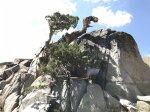
The nice thing about junipers is that their growth habits in the wild are so diverse. Not only that but wild and crazy and beautiful forms are quite common out there, they naturally grow like bonsai. Or bonsai are very often designed to look like crazy junipers? Given the diversity of form in the wild almost any juniper bonsai could be interpreted as naturalistic really. Sure some might be seen as over manicured past the point of natural but the rough outline form, bones can probably be found in nature out there somewhere. image.jpgimage.jpg
They also grow into big tall normal trees too sometimes. image.jpgimage.jpg
Sorry not the best examples, no time to dig up better ATM.
 
Oh yeah naturalistic applies to junipers!

The nice thing about junipers is that their growth habits in the wild are so diverse. Not only that but wild and crazy and beautiful forms are quite common out there, they naturally grow like bonsai. Or bonsai are very often designed to look like crazy junipers? Given the diversity of form in the wild almost any juniper bonsai could be interpreted as naturalistic really. Sure some might be seen as over manicured past the point of natural but the rough outline form, bones can probably be found in nature out there somewhere. View attachment 168151View attachment 168152
They also grow into big tall normal trees too sometimes. View attachment 168153View attachment 168154
Sorry not the best examples, no time to dig up better ATM.
That's awesome, thanks!
 
I agree, thanks for the examples and I hope people have noticed; none of these trees fit into the by the numbers enumeration of styles and forms as found in the standard teachings of bonsai. Some are close but no cigar, they stand on their own as both naturalistic and Yamadori styles. I believe that the Japanese do accept something as Yamadori style which is another way of saying Naturalistic style.
 
Yes there is always beauty when this stuff happens; nature doing its own thing.
 
@Vance Wood ; I still don't understand how Fibonacci applies to styling bonsai. Could you explain a bit more?
The best place to start is with the Fibonacci Spiral and the Fibonacci Sequence. I have a dinner appointment I have to leave for so I don't have time to bring it all out at this moment but here is a short coverage. In bonsai because of pruning and wiring we have the ability to alter the natural Fibonacci design of the trees we are working on and giving out trees another rendering of the Fibonacci Sequence. The Fibonacci Spiral demands that all out vertical or upward growth is in a Spiral where all of the elements are numerically related to each other in a sequence of; 0---1--1--2--3--5---8--13---21 etc until the elements are exhausted. This principle is the production of fractals which are the continual repetition of the same or similar pattern over and over and over. This is called self similarities. In music we would call this variations on a theme. So if you are forcing a tree into a form that the tree may not be naturally prone to assume, the closer you follow the Fibonacci pattern the more natural your design will appear. Sometimes this stuff is not easy to see in some trees sometimes it is possible, but what helps you out is in determining that you have broken the Fibonacci sequence in one area; this will be where you will have a design problem.
 
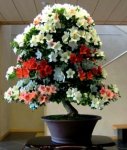
Even within the azalea groups, there are two factions: one that tries to grow azalea to resemble pine trees, and look more like traditional bonsai, and the other faction grows them initially as tall whips so the trunks are relatively thin and taperless. These have branches spaced out to provide room for the flowers to open without contacting the branches above. These styles are designed to maximize the effect of the flowers, and not necessarily adhere to the standard aesthetics of traditional bonsai.
Here is an azalea that has sort of a singular look, which grouping would you place this one?
P1020558.jpg
 
Here is an azalea that has sort of a singular look, which grouping would you place this one?
View attachment 168288
Lol!!! Look at the picture of Dave De Groot’s book that Bill just posted! That azalea looks just like that Pine!

Here are pictures of azalea grown in the “flower display style”

8F1CF54D-D966-49C3-9A14-45ACBBDC37D3.jpeg 3415E96E-0FD8-449D-8A9D-4576954AE20A.jpeg 156D1718-4B40-427E-8F6A-9918687CC92C.jpeg EABF027D-5883-4A06-BEFF-9C99D7670919.jpeg

Notice that they are full of blooms. Often those who are more into “bonsai” than “flowers” will thin the blooms out so that the structure is more apparent. Notice also that these have relatively thin trunks. And are more columnar.
 
Does the "naturalistic" style apply to junipers??
How bout azaleas??

Have you ever seen a juniper bonsai that looks like a mature juniper???

How bout an azalea bonsai that looks like a mature Azalea???

What does a mature Azalea, in the wild, even look like???

Any examples?
I don't think the "naturalistic style" is necessarily about, nor abides to being true to a species propensities, it's about looking natural. I once saw a really cool forest that made up of hemlocks to look like island bound white pines and small shimpakus were used to look like shrubby white cedar understory, dwarf cotoneasters sprawled low as the ground yews, small Kusiatum azaleas made deciduous trees--it all looked very natural.
 
I don't think the "naturalistic style" is necessarily about, nor abides to being true to a species propensities, it's about looking natural. I once saw a really cool forest that made up of hemlocks to look like island bound white pines and small shimpakus were used to look like shrubby white cedar understory, dwarf cotoneasters sprawled low as the ground yews, small Kusiatum azaleas made deciduous trees--it all looked very natural.
That's the point; the naturalistic style must look natural and uncontrived.
 
That's the point; the naturalistic style must look natural and uncontrived.
I think, in many cases, trees can be shaped in shapes not typical of their species and still be done in a naturalistic way and be considered of the naturalistic style--some people say this is a no-no in the naturalistic style. I think there is a limit though.
 
Well, it does to look unnatural to me when I see pine-treed elms.
In you mind it would be a reason not to do it that way. How about something that seems more plausible? So,--- what about something a bit more plausible, how would that be defined?
 
In you mind it would be a reason not to do it that way. How about something that seems more plausible? So,--- what about something a bit more plausible, how would that be defined?
True, true. I guess the main definer is naturalism in form not plausibility in form.
 
The nice thing about junipers is that their growth habits in the wild are so diverse. Not only that but wild and crazy and beautiful forms are quite common out there, they naturally grow like bonsai. Or bonsai are very often designed to look like crazy junipers? Given the diversity of form in the wild almost any juniper bonsai could be interpreted as naturalistic really. Sure some might be seen as over manicured past the point of natural but the rough outline form, bones can probably be found in nature out there somewhere. View attachment 168151View attachment 168152
They also grow into big tall normal trees too sometimes. View attachment 168153View attachment 168154
Sorry not the best examples, no time to dig up better ATM.
[/QUOTE]

Here is a good example of design without enough consideration of nature and working on auto pilot. I don't blame anyone in particular and I do it myself, but it helps to at least be aware of it when considering naturalistic or ''natural'' looking styles.
In the ''designed'' tree you can see what 99.9% of people do (and that includes all of the ''masters'' ) when they shape the crown of the tree. I won't say 100% because there may be someone who does not do this or seeks to avoid it? They have it firmly fixed in their DNA that we must bring branches down, that we must have a ''main'' branch that dictates the flow of the tree and that this branch must be end in a point and that there must be some kind of triangle to the shape of the crown regardless of the base of the tree. The truth is that real weather beaten trees are completely dependant of the forces of nature - especially the wind - and they usually do not conform to our pre-conceived shallow concepts of beauty. When we start to do away with these concepts and start to really look and appreciate that nature is the true master, we might then start to free up the possibilities which have been either frowned upon or not even realized till now. I have not seen anyone talk about this - not even W. Pall!
In the first example it is very obvious that no consideration at all was given to naturalism, and yet again we have fallen back on text book design rather than try to speculate what really would happen if such a tree were in the mountains and have to deal with a harsh existence and all the weather coming from one main direction. The denser the canopy of this tree becomes the more distant from naturalism it will go. I think it's time we give more thought to the formation of the base of the tree as it presents before we go ahead and blindly shape the crown as we have a million times before. This is the very essence of contrivance with the result of artificiality. No matter how wild or convoluted the trunk and main branches may be we feel the urgent need to ''tame'' the tree by putting a green triangle on top of it.

natjun.JPG


natjun2.JPG
 
Back
Top Bottom