
You are using an out of date browser. It may not display this or other websites correctly.
You should upgrade or use an alternative browser.
You should upgrade or use an alternative browser.
Soil component
- Thread starter crust
- Start date


davetree
Omono
Both made from expanded shale or slate. I have seen hadite come in different forms and textures so I think it depends on the manufacturing process. You might have to ask the people who make it.
These business's are nearly industrial(Permitil etc.)--I doubt they would answer with anything but promotional spewings.Both made from expanded shale or slate. I have seen hadite come in different forms and textures so I think it depends on the manufacturing process. You might have to ask the people who make it.

rockm
Spuds Moyogi
From the Permatill and "Haydite" that I've used in the past, the Permatill (Staylite) is a much much larger particle. Too big to really be of much use in bonsai soil, perhaps as a drainage layer...
The haydite can vary from location, I've found. What I call haydite might not be what someone down in Texas would call it, or Michigan, or wherever. It's usually locally made.
The haydite can vary from location, I've found. What I call haydite might not be what someone down in Texas would call it, or Michigan, or wherever. It's usually locally made.
davetree
Omono
I have seen hadite look like small turface and also like smooth 1/4 inch spheres. The small balls hurt like hell when you step on one barefoot. And you are right, now that I think about it, I called a manufacturer and they thought I was nuts. There have been some turf studies done that show the aeration and water retention capabilities of these different products, but again they all seem manufactured a little differently, maybe with different kinds of shale.
Last edited:
From the Permatill and "Haydite" that I've used in the past, the Permatill (Staylite) is a much much larger particle. Too big to really be of much use in bonsai soil, perhaps as a drainage layer...
The haydite can vary from location, I've found. What I call haydite might not be what someone down in Texas would call it, or Michigan, or wherever. It's usually locally made.
Actually Stalite is obtainable in small-3/16 - 5/16 inch or Medium-1/2" particle size.
Bill S
Masterpiece
These business's are nearly industrial(Permitil etc.)--I doubt they would answer with anything but promotional spewings.
Surprisingly I have had good luck with getting responses over the years, worth the try. I still get a call once in a while from India from a lime sulpher mfg., doing follow ups. I was looking for a case of bottles they sell by the shipping container, we weren't compatible.
Last edited:
I already know from research that Haydite and Stalite are essentially the same: heat expanded shale granules.I also have picked up that various plants and possibly various times in prodution the products are made different--significantly different (less pourous, more ball-like) How ever I was seeking someone who may actually use the different stuff and note the all important differences.
This whole research is driven by my need for a more water retentive inorganic soil component that would mimic what akadama does for lava/pumice mixes. I also have found that the "green roof industry" and concrete additive companies has spawned products that might be applicable, usually heat expanded shales or expanded fire clays. Turface will work for me but getting coarse material takes allot of product and sifting plus the stuff is not bubbly inside. Its so funny that the UK has a ton of horticultural medias being made and successively used there but here in the US there is squat.
This whole research is driven by my need for a more water retentive inorganic soil component that would mimic what akadama does for lava/pumice mixes. I also have found that the "green roof industry" and concrete additive companies has spawned products that might be applicable, usually heat expanded shales or expanded fire clays. Turface will work for me but getting coarse material takes allot of product and sifting plus the stuff is not bubbly inside. Its so funny that the UK has a ton of horticultural medias being made and successively used there but here in the US there is squat.
davetree
Omono
So you're looking for a replacement for Akadama. There is a lot of different clays around your state, maybe it can be home made ?
No no no, unstabilized field clay has proven to be bad voodoo for everyone. If it is dried and granulized it just returns to its mush state quickly. If you fire it to a nearly vitrified state then you have a fired clay product like Turface. I really don't want anything just like akadama besides akadama is subtly unique and from my understanding is due to its volcanic origin and the way it is deposited. I am just looking for a "wetter" soil component. If you line up available soil components and measure retention and capillary abilities (be done over and over) you will see the pourous materials such as hadite, lava, pumice, perlite etc. don't retain much water so there is always a component such as peat, bark, akadama or whatever that balances this and makes of a free draining yet retentive mix. I have wondered if I could add a expanding agent (foaming agent) to a clay and fire it just enough to mostly vitrify it if that would be a good component. There is a orchid geek out there that actually sells some stuff like this called PrimeAgra® but only gets it in coarse(8-16 mm)--he says there is no market for the finer(4-8mm)stuff.The site is interesting http://www.firstrays.com/
davetree
Omono
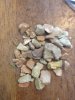
Here's something to think about. Down at the local hydroponics store there are many kinds of growing medium for sale. In fact I have a few bags of different stuff that I haven't tried yet. Here are two examples. The gray one is very hard shale fired at 2000 degrees. Like Turface only bigger and more irregular. Supposedly holds a lot of water while retaining O2. The second lighter colored is a bit softer, about like hard Akadama. It is described as an opaline siliceous sedimentary rock. I can break it in two but it won't crumble. It comes in four different sizes from very fine to coarse. They are both reusable ! I haven't used these products yet but they look promising. The gray one is Sunleaves Rocks, the lighter one is Dyna-Grow's Dyna-Rocks II.

davetree
Omono
I think that the Dyna Rocks II is maybe close to what you are looking for ?
davetree
Omono
I think it is about $1/liter. But you can reuse it, which brings the price down, and how much do you really need ? And it is available locally so no shipping costs.
davetree
Omono
Midwest Hydroponics in St. Louis Park. If you are way up north, Duluth has the Indoor Tomato which sells Hydro Lite, similar but cheaper at $32 for 1.5 cu. ft. Midwest has Dyna Rok for $50, in Duluth it is $72. Midwest will ship. Also I think Dyna Rock is made by the same guys who make Bonsai Pro liquid fertilizer. I have not looked at Hydro Lite, but it is a silica based medium.

JudyB
Queen of the Nuts
If more moisture retention is your aim, then Turface is your substrate. And I've found that I can manipulate moisture even within turface batches, by how I screen it.
I've moved to a haydite mix this past year on some trees, and will move the rest this year. What I have found is that I'll need to mix a bit of screened turface into the haydite mix for my trees that need extra moisture. But the haydite does a decent job alone (in the mix, which is haydite/river rock/bark), it's just not quite as retentive as turface. I did a test of just the haydite and turface.... that is how I got my info on that.
Haydite for me is relatively inexpensive, there is a plant here in Ohio.
I've moved to a haydite mix this past year on some trees, and will move the rest this year. What I have found is that I'll need to mix a bit of screened turface into the haydite mix for my trees that need extra moisture. But the haydite does a decent job alone (in the mix, which is haydite/river rock/bark), it's just not quite as retentive as turface. I did a test of just the haydite and turface.... that is how I got my info on that.
Haydite for me is relatively inexpensive, there is a plant here in Ohio.
davetree
Omono
I think the silicon based medium will hold more moisture than Turface, while retaining more O2. It also comes in 4 sizes which is very convenient for making your own mixes. Turface is too small for some things. I use Turface as a main ingredient but am also looking for an Akadama replacement. I see you use bark, Judy, but I don't use anything organic in my soil mix. This stuff is 3x as expensive as Turface, but it can be reused indefinitely so I guess it really doesn't cost more.
Thanks Dave--I will check out MH.Midwest Hydroponics in St. Louis Park. If you are way up north, Duluth has the Indoor Tomato which sells Hydro Lite, similar but cheaper at $32 for 1.5 cu. ft. Midwest has Dyna Rok for $50, in Duluth it is $72. Midwest will ship. Also I think Dyna Rock is made by the same guys who make Bonsai Pro liquid fertilizer. I have not looked at Hydro Lite, but it is a silica based medium.
The stuff I am considering is called "Higromite" and yes it is a silica formed around volcanic ash . It was recommended by Ray the orchid guru. Supposedly different from zeolites and diatomite Used allot by home herb (ahumm) hydro and semi hydro growers.
Hydrolite is a more pure zeolite. All this stuff evidently have there own subtle characteristic but I suspect the grading and grain size will affect its usability for me--allot of it is pretty coarse.
Similar threads

- Replies
- 17
- Views
- 5K


- Replies
- 3
- Views
- 2K


- Replies
- 9
- Views
- 2K


